Finding a reliable shipping agent to Philippines can be challenging when you need competitive freight rates, suitable container space, and dependable customs coordination. Delays, incomplete shipping documents, and shipments collected from multiple suppliers can complicate your import operations and increase costs. Choosing the right sea freight partner helps you plan each stage, from cargo collection in China to destination handling in the Philippines.
Honza Logistics provides international freight forwarding services, including full container load (FCL), less than container load (LCL), booking, warehousing, and customs clearance assistance. Established in Shenzhen in 2013, the company operates branches in several major Chinese logistics hubs. This guide explains how to select a shipping solution for your cargo and what to prepare before booking.
Why Choose a Shipping Agent to Philippines?
Working with a China-based freight forwarder can simplify communication with suppliers, shipping lines, warehouses, and customs service providers. Instead of coordinating each stage separately, you can discuss your cargo requirements with one logistics partner.
Honza Logistics provides international sea freight and related logistics services. The company reports that it is registered as a Non-Vessel Operating Common Carrier (NVOCC) with China’s Ministry of Transport and received SGS approval in 2020.
Its services include:
- Sea freight booking: Arrange container space and select a suitable shipping option.
- FCL and LCL shipping: Choose between a dedicated container and consolidated cargo.
- Warehousing and consolidation: Combine goods from multiple suppliers before shipment.
- Customs clearance assistance: Coordinate export and import documentation with the relevant service providers.
- Cargo insurance arrangements: Discuss available coverage for your shipment.
- Shipment tracking: Request updates throughout the transportation process.
These services can help importers, wholesalers, manufacturers, and e-commerce businesses organize shipments from China to the Philippines.
FCL vs. LCL Shipping to the Philippines
Your shipment volume, cargo characteristics, budget, and delivery requirements determine whether FCL or LCL is the better choice.
Full Container Load (FCL)
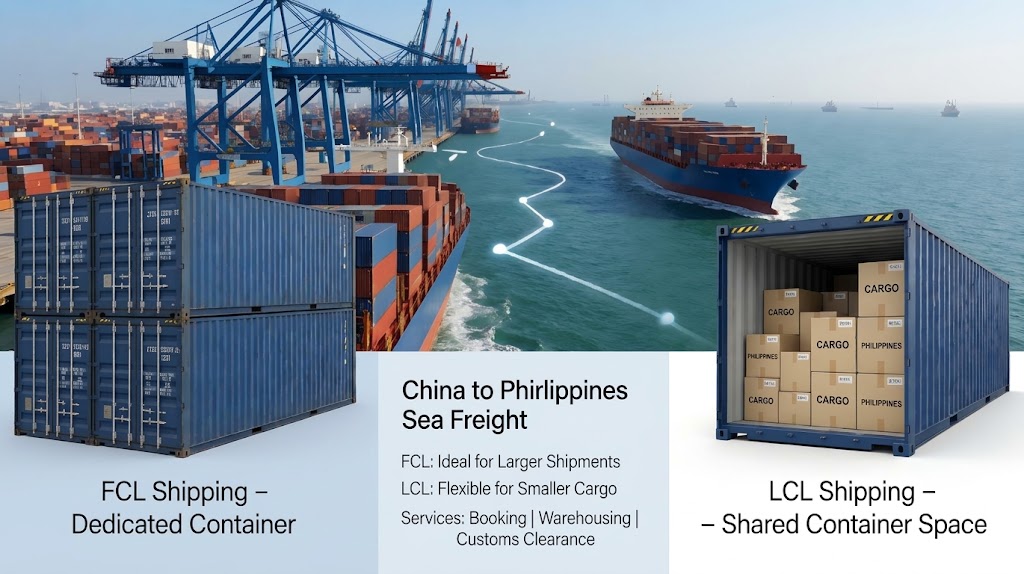
FCL shipping uses a container allocated to your shipment. Honza Logistics lists standard container options, including 20GP, 40GP, 40HQ, and 45HQ, as well as specialized equipment such as open-top, flat-rack, and refrigerated containers.
FCL may suit you when:
- You have enough cargo to justify using a dedicated container.
- You need to ship larger or heavier consignments.
- You want to reduce the handling associated with cargo consolidation.
- Your shipment requires specific container equipment, subject to availability.
Less than Container Load (LCL)
LCL shipping consolidates cargo from multiple shippers into one container. It can be useful when you purchase products from several Chinese suppliers but do not have enough goods to fill a complete container.
For example, a Philippine retailer sourcing accessories from Shenzhen and household products from Guangzhou could arrange warehouse consolidation before shipping. This approach may help reduce the cost of booking an entire container, although consolidation, handling, and destination charges still need to be considered.
| Factor | FCL Shipping | LCL Shipping |
|---|---|---|
| Cargo volume | Larger shipments | Smaller shipments |
| Container space | Dedicated to your shipment | Shared with other cargo |
| Consolidation | Usually not required | Required |
| Cost structure | Container-based quotation | Often based on chargeable volume or weight |
| Suitable for | Bulk goods and larger consignments | Smaller orders and multiple suppliers |
Ask for a complete quotation covering origin charges, ocean freight, destination handling, customs-related charges, and final delivery if required. Actual charges depend on the cargo, route, shipment terms, and service scope.
China Loading Ports and Cargo Options
Honza Logistics lists Shenzhen, Guangzhou, Shanghai, Ningbo, Xiamen, Tianjin, and Qingdao as Chinese loading ports. Your best departure port depends on your suppliers’ locations, available sailing schedules, inland transportation costs, and the destination port in the Philippines.
The company also lists open-top, flat-rack, and refrigerated container services. These options may be relevant for machinery, oversized equipment, or temperature-sensitive goods, provided the cargo and route meet the carrier’s requirements.
Before confirming a booking, provide your freight forwarder with the following details:
- Cargo description and intended use
- Number of cartons, pallets, or packages
- Total gross weight and cargo dimensions
- Supplier addresses and preferred loading port
- Destination city or port in the Philippines
- Required delivery terms, such as port-to-port or door-to-door
Accurate information allows the logistics team to assess equipment requirements and prepare a more suitable quotation.
How to Arrange Sea Freight from China to the Philippines
Follow these five steps to organize your shipment more efficiently.
- Confirm your cargo details. Collect packing lists, commercial invoices, dimensions, weights, and any applicable product permits.
- Request a shipping quotation. Compare FCL and LCL options, departure ports, sailing schedules, and the charges included.
- Arrange cargo collection or warehouse delivery. If you use several suppliers, ask whether the forwarder can consolidate your goods.
- Confirm documentation and customs requirements. Check import eligibility, duties, taxes, and any product-specific permits with the appropriate customs broker or authorities.
- Track the shipment and arrange delivery. Confirm destination handling, cargo release requirements, and whether inland delivery is included in your booking.
Planning these steps before cargo dispatch can help reduce documentation errors and unexpected charges.
FAQ
1. How do I choose a shipping agent from China to the Philippines?
Compare the agent’s service scope, experience, quotation details, communication, and ability to coordinate the required route. Confirm which services are included and which charges are payable separately.
2. Is FCL or LCL cheaper for shipping to the Philippines?
LCL can be economical for smaller shipments because you share container space. FCL may offer better value for larger volumes. Compare complete quotations rather than ocean freight alone.
3. Can Honza Logistics arrange customs clearance and delivery?
Honza Logistics lists customs clearance assistance, warehousing, and delivery-related services among its logistics offerings. Confirm availability, destination coverage, documentation requirements, and the exact charges for your shipment before booking.
Conclusion
Choosing the right shipping agent to Philippines helps you coordinate freight booking, cargo consolidation, container selection, and customs-related arrangements. Honza Logistics offers FCL and LCL services from multiple Chinese loading ports, giving importers different options based on cargo volume and shipping needs. Before committing, compare the full shipping cost, verify destination arrangements, and confirm the service scope in writing.
Request a China-to-Philippines Sea Freight Quotation
Contact Honza Logistics with your cargo dimensions, gross weight, supplier location, destination, and preferred shipping terms. Ask for an itemized FCL or LCL quotation so you can evaluate the costs and plan your next shipment with greater clarity.