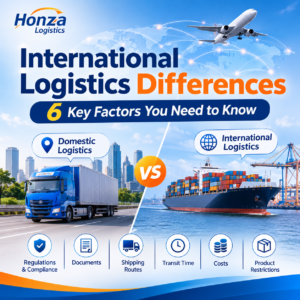
If you ship products overseas, understanding international logistics differences can help you avoid unexpected costs, customs delays, and delivery problems. Domestic shipping may take only a few days, but cross-border transportation involves more than moving goods from one location to another.
You must also consider export declarations, import customs clearance, international freight rates, destination-country regulations, and local delivery arrangements. For businesses selling internationally or shipping products to Amazon fulfillment centers, these factors directly affect delivery schedules and operating costs.
Honza Logistics, established in Shenzhen in 2013, provides international sea freight, air freight, customs clearance, warehousing, and e-commerce logistics services. Understanding the six differences below will help you select a suitable shipping method and prepare your shipments more effectively.
Customs Regulations and Compliance
Domestic logistics operates mainly under one country’s transportation and shipping regulations. Once a parcel meets the carrier’s acceptance requirements, it can generally move through the domestic delivery network without international customs procedures.
International logistics requires compliance with both export regulations and the destination country’s import requirements. Depending on the goods and route, you may need to provide product declarations, permits, certificates, or tax information.
For example, imports into Mexico may require an RFC tax identifier and applicable customs documentation. Certain products entering Brazil may also require specific regulatory approvals. Requirements vary by product category and current local rules.
Key difference: Domestic shipping focuses primarily on transportation compliance, while international shipping also requires customs and trade compliance.
Shipping Documents and Paperwork
Domestic shipments generally require a shipping label containing the sender’s and recipient’s information. International shipments need more detailed documentation to support customs declarations and cargo handling.
Common international shipping documents include:
- Commercial invoice: Describes the goods, their declared value, and the parties involved.
- Packing list: Shows package quantities, weights, and dimensions.
- Customs declaration: Provides information required for export or import processing.
- Bill of lading or air waybill: Records essential details of the international transportation arrangement.
- Additional certificates: May be necessary for regulated goods, preferential tariff claims, or specific destination requirements.
Incorrect product descriptions, inconsistent declared values, or unsuitable HS codes can trigger additional checks and clearance delays. Before shipping, ensure that your documents accurately reflect the actual cargo.
Transportation Routes and Logistics Partners
Domestic delivery often follows a relatively straightforward route: collection, sorting, line-haul transportation, local distribution, and final delivery.
International shipments usually involve several independent service providers. Depending on the shipping method, your cargo may pass through a domestic trucking company, freight forwarder, port or airport operator, customs broker, and destination-country delivery company.
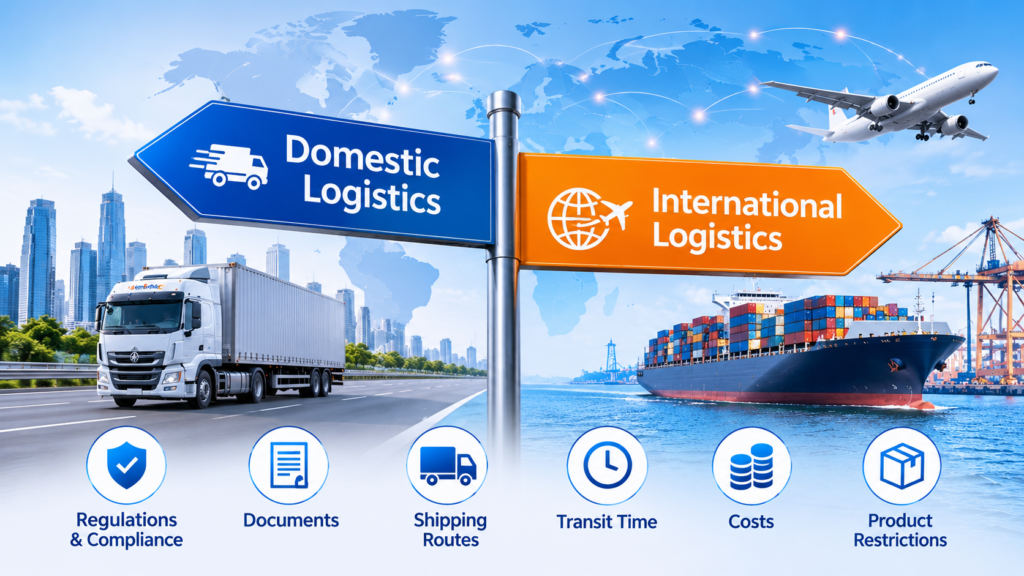
| Comparison | Domestic Logistics | International Logistics |
|---|---|---|
| Transportation scope | Within one country | Across national borders |
| Customs clearance | Generally not required | Usually required |
| Main documents | Shipping label | Invoice, packing list, transport documents, and declarations |
| Transit time | Often shorter and more predictable | Depends on route, customs, and transport mode |
| Cost structure | Often simpler | Freight, clearance, duties, taxes, and possible surcharges |
| Compliance | Primarily domestic rules | Export and destination-country requirements |
Honza Logistics offers sea freight, air freight, international courier, rail transportation, trucking, and door-to-door shipping services. The right option depends on your cargo, budget, delivery deadline, and destination.
Transit Time and Delivery Reliability
Domestic shipping benefits from established transportation networks and fewer international handoffs. Delivery times still vary by distance, carrier, weather, and seasonal demand.
International transit times depend on several additional factors, including sailing schedules, flight availability, port congestion, customs inspections, and local holidays. Sea freight generally suits larger shipments that can accommodate longer transit times, while air freight is useful for urgent or time-sensitive cargo.
Before booking, ask your freight forwarder to clarify:
- Estimated transit time and the starting point used for the estimate.
- Whether the quotation includes customs clearance and final delivery.
- Potential delays during peak shipping seasons.
- How shipment tracking and delay notifications are handled.
A realistic delivery estimate should account for the entire shipping process, not just the international transportation leg.
Shipping Costs and Additional Charges
Domestic carriers often provide relatively simple rates based on parcel weight, dimensions, distance, or service level. International freight quotations can contain several separate cost components.
Depending on your route and shipping arrangement, the total cost may include:
- Domestic pickup and export handling.
- International air or ocean freight.
- Customs brokerage and documentation fees.
- Import duties and taxes.
- Destination handling and last-mile delivery.
- Storage, inspection, demurrage, detention, or amendment fees when applicable.
For example, a low ocean freight rate may not represent the lowest total landed cost if destination handling, customs clearance, and delivery are excluded. Compare quotations using the same shipment details and service scope.
Honza Logistics provides freight forwarding and customs clearance services to help customers coordinate these arrangements. Confirm all inclusions, exclusions, and possible surcharges before dispatch.
Product Restrictions and Import Requirements
Domestic carriers follow their applicable prohibited-item and packaging rules. International shipments face additional restrictions because each destination may have different product standards, labeling rules, and import controls.
Products such as batteries, food, cosmetics, liquids, powders, and medical devices may require special handling or supporting documentation. Some goods may also need specific certifications or import permits before customs will release them.
Use this practical process before shipping internationally:
- Identify the destination: Confirm the final country and delivery address.
- Classify your goods: Prepare an accurate product description, HS code, quantity, and declared value.
- Check import requirements: Verify applicable restrictions, permits, labeling rules, and taxes.
- Choose a shipping method: Compare air, sea, rail, courier, or trucking based on cost and urgency.
- Confirm the quotation: Check customs responsibilities, delivery scope, and potential extra charges.
- Track the shipment: Monitor transportation progress and respond promptly to requests for additional documents.
Preparing these details in advance can reduce avoidable clearance issues and improve shipment planning.
FAQ
1. What is the main difference between domestic and international logistics?
Domestic logistics moves goods within one country. International logistics crosses national borders and typically involves export and import customs procedures, additional documents, and destination-specific regulations.
2. Is international shipping always more expensive?
Not necessarily. International shipping costs depend on cargo size, weight, destination, shipping method, and service scope. Sea freight can be economical for larger shipments, while air freight usually prioritizes speed over transportation cost.
3. How can you reduce international shipping delays?
Prepare accurate shipping documents, confirm import requirements before dispatch, select an appropriate transportation method, and work with a freight forwarder that can coordinate customs clearance and delivery.
Conclusion
Understanding international logistics differences helps you make better shipping decisions, control total costs, and prepare for customs requirements. By comparing documentation, transportation routes, transit times, charges, and product restrictions, you can choose a shipping solution that fits your business needs.
Need help planning your next shipment? Contact Honza Logistics to discuss your cargo, destination, delivery timeline, and budget. Our team can help you evaluate available freight options, customs clearance arrangements, and door-to-door delivery services before you ship.