Shipping to Thailand is a key trade route for global importers, especially for cargo moving from China to Southeast Asia. However, many businesses face the same problems: unstable transit times, unclear destination charges, and customs delays in Thailand.
The issue is not only transportation itself, but the lack of a structured logistics system that connects origin handling, ocean freight, and Thai import clearance.
Honza Logistics provides end-to-end sea freight solutions designed to make shipping to Thailand predictable, cost-controlled, and customs-compliant.
Why Shipping to Thailand Often Becomes Unpredictable
Before choosing a shipping method, it’s important to understand why delays and extra costs happen in the first place.
Most problems occur in three areas:
- Destination charges in Thailand that are not clearly explained at origin
- Customs clearance delays caused by incomplete or incorrect documentation
- Poor coordination between multiple suppliers and carriers
In other words, shipping itself is not the issue. The breakdown happens in the logistics chain between China and Thailand.
This is why structured freight forwarding plays a critical role in international shipping efficiency.
How Freight Forwarders Manage Shipping to Thailand
A freight forwarder acts as a logistics coordinator between shippers, carriers, and customs authorities. They do not operate vessels, but they manage the entire shipping process.
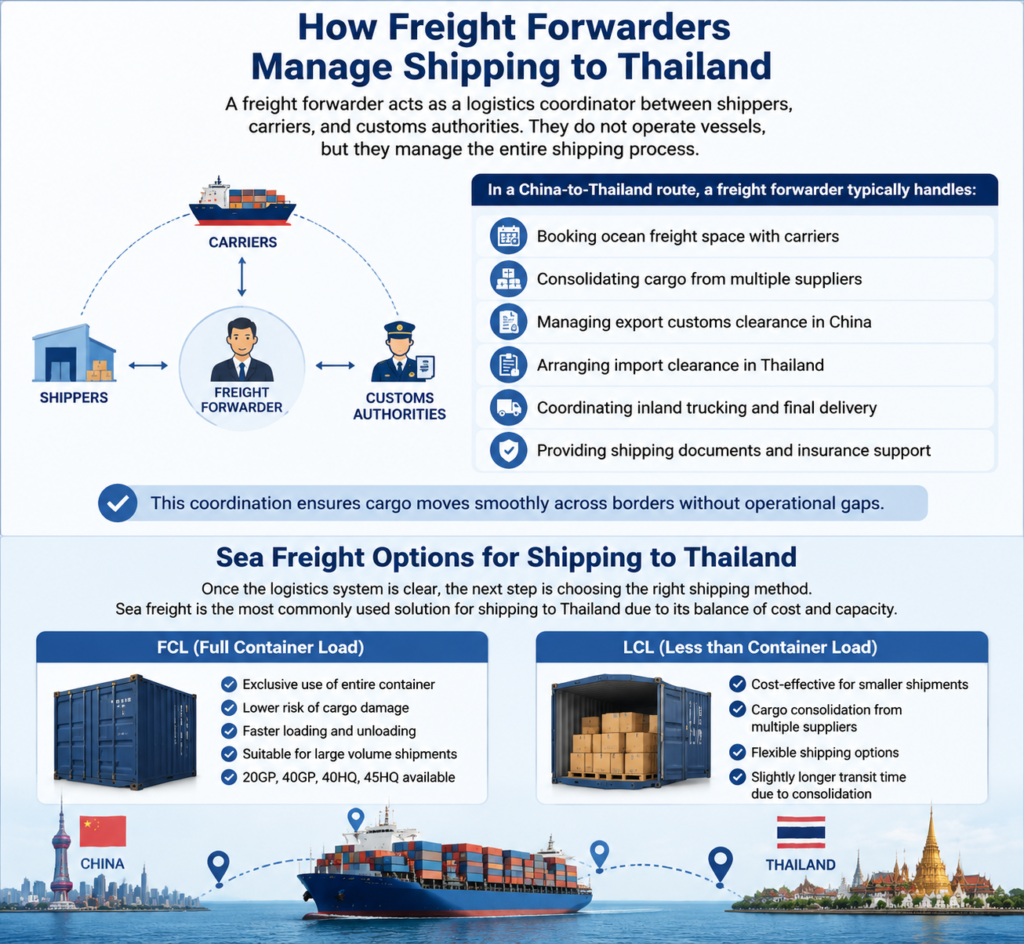
In a China-to-Thailand route, a freight forwarder typically handles:
- Booking ocean freight space with carriers
- Consolidating cargo from multiple suppliers
- Managing export customs clearance in China
- Arranging import clearance in Thailand
- Coordinating inland trucking and final delivery
- Providing shipping documents and insurance support
This coordination ensures cargo moves smoothly across borders without operational gaps.
Sea Freight Options for Shipping to Thailand
Once the logistics system is clear, the next step is choosing the right shipping method.
Sea freight is the most commonly used solution for shipping to Thailand due to its balance of cost and capacity.
FCL Shipping (Full Container Load)
FCL means one shipper uses a full container exclusively.
It is suitable when shipment volume is stable or large.
Key characteristics:
- Full container options: 20GP, 40GP, 40HQ, 45HQ
- No mixing with other cargo
- Lower risk of damage or misrouting
- More stable customs processing
Typical use cases:
- Machinery exports
- Industrial goods
- Large retail replenishment orders
FCL is generally preferred when cost per unit needs to be optimized at scale.
LCL Shipping (Less than Container Load)
LCL is used when cargo volume is not enough for a full container.
Multiple shipments are consolidated into one container.
Key characteristics:
- Pay based on CBM volume
- Consolidation in China warehouse hubs
- Flexible for small or irregular shipments
- Slightly longer handling time due to grouping process
Typical use cases:
- E-commerce sellers
- Small manufacturers
- Sample or trial shipments
LCL is often the entry point for businesses testing the Thailand market.
China to Thailand Shipping Routes and Transit Time
After selecting the shipping method, route planning determines delivery speed and stability.
Common origin ports in China include:
- Shenzhen
- Guangzhou
- Ningbo
- Shanghai
- Qingdao
- Xiamen
Typical transit times:
- South China → Thailand: 3–7 days
- East/North China → Thailand: 7–15 days
- LCL shipments: 10–18 days (including consolidation time)
Main destination hubs in Thailand:
- Laem Chabang Port (primary deep-sea container port)
- Bangkok Port (regional distribution)
- Lat Krabang ICD (inland customs clearance hub)
These hubs form the backbone of Thailand’s import logistics network.
Thailand Customs Clearance and Key Risk Points
Even when ocean freight is smooth, customs clearance can become the main bottleneck in shipping to Thailand.
Common issues include:
- Incorrect HS code classification
- Missing Form E certificate for tariff reduction under ASEAN agreements
- Invoice value discrepancies
- Incomplete or inconsistent packing lists
- Random inspection by Thai customs authorities
Thailand applies import duties and VAT based on declared HS codes and shipment value. Therefore, documentation accuracy directly impacts clearance speed and cost.
Step-by-Step Shipping to Thailand Process
To ensure predictability, a standard shipping workflow is usually followed:
- Cargo booking and route confirmation
- Pickup from suppliers across China
- Export customs declaration
- Cargo consolidation (for LCL shipments)
- Ocean freight transportation
- Import customs clearance in Thailand
- Duty and tax processing
- Final delivery to warehouse or distribution center
When each step is properly coordinated, delays and hidden charges are significantly reduced.
Sea Freight vs Air Freight for Thailand
Different shipping methods serve different business needs.
| Factor | Sea Freight | Air Freight |
|---|---|---|
| Cost | Lower | Higher |
| Transit Time | 3–15 days | 1–5 days |
| Best For | Bulk, commercial cargo | Urgent shipments |
| Customs Pressure | Moderate | Higher |
Sea freight remains the preferred choice for shipping to Thailand when cost efficiency and scalability are priorities.
When Businesses Use Shipping to Thailand
Shipping to Thailand is commonly used in several real-world supply chain scenarios:
- E-commerce inventory replenishment (Amazon, Shopee, Lazada sellers)
- Machinery and industrial equipment import
- Retail distribution across Southeast Asia
- Multi-supplier consolidation from different Chinese factories
- Long-term warehouse stocking for Thai distributors
Example scenario:
A company consolidates shipments from multiple suppliers in Shenzhen and Ningbo, ships via LCL to Laem Chabang, clears customs in Bangkok, and distributes goods to regional warehouses within Southeast Asia.
Why Structured Freight Forwarding Matters
At this stage, the decision is not just about shipping method, but about control.
Without a structured system, importers face:
- Unpredictable destination fees
- Customs delays
- Supplier coordination issues
With structured freight forwarding, the entire process becomes measurable and repeatable.
Honza Logistics supports shipping to Thailand with:
- Transparent pricing without hidden destination charges
- FCL, LCL, and DDP shipping solutions
- Carrier networks including MSK, MSC, CMA CGM, COSCO, ONE
- Form E documentation support for tariff optimization
- Multi-supplier consolidation across China
FAQ
1. What is the cheapest shipping option?
LCL sea freight is the most cost-effective option for small and medium shipments.
2. What documents are required?
- Commercial invoice
- Packing list
- Bill of lading
- Form E certificate (for ASEAN tariff benefits)
Conclusion
Shipping to Thailand is not simply a transportation service. It is a coordinated logistics system involving freight forwarding, customs compliance, and inland distribution.
When each part of the chain is managed properly, businesses gain predictable transit time, controlled costs, and smoother customs clearance.
For importers shipping from China to Thailand, structured sea freight solutions remain the most reliable and scalable approach for long-term trade growth.
CTA
Request a customized shipping plan for Thailand, including FCL, LCL, and DDP options tailored to your cargo volume, supplier locations, and delivery requirements.